The LMS Needs a Map
By
Dr. Perry J. Samson



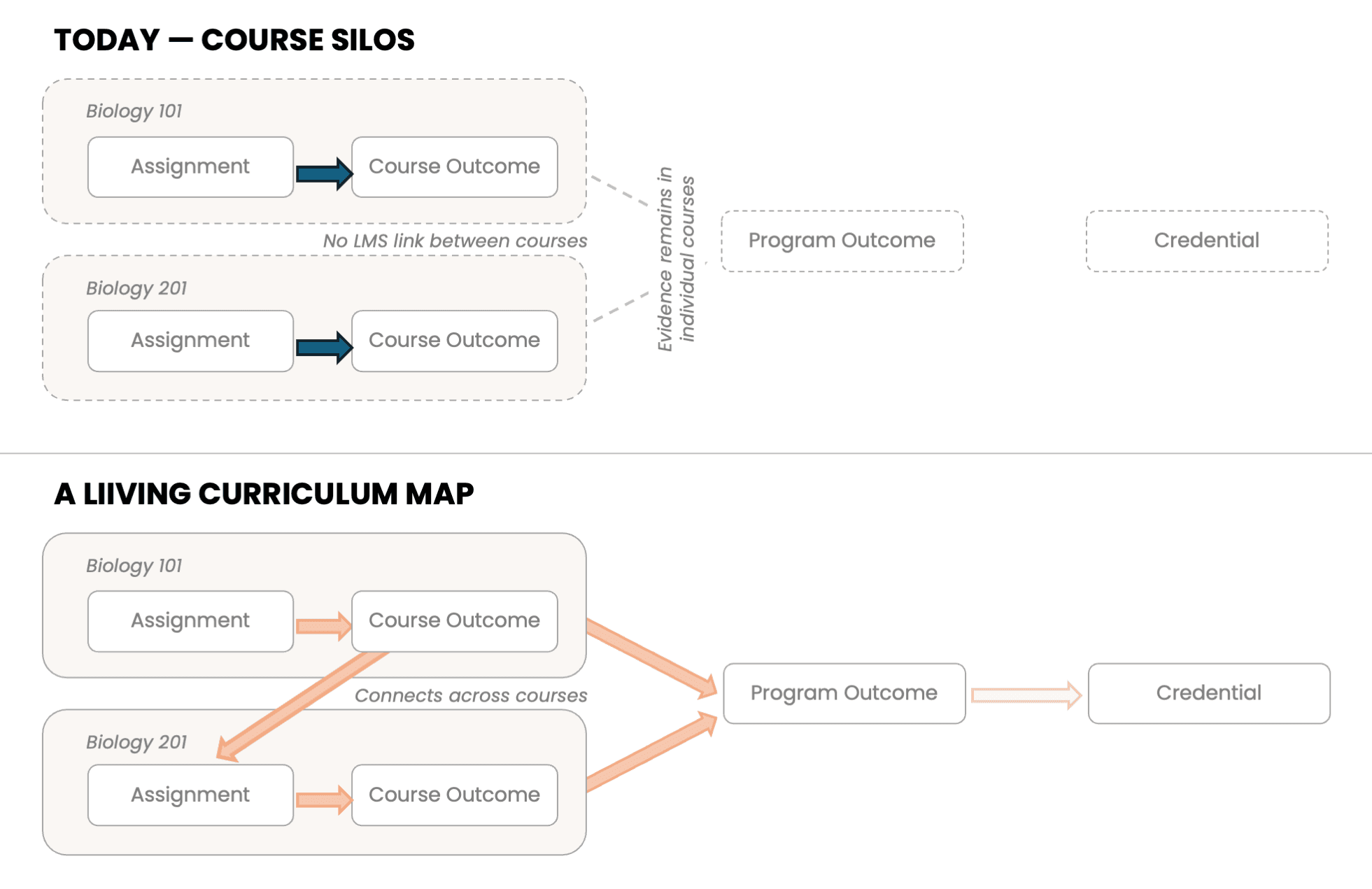
Matthew Pittinsky’s Mark Hopkins’ Log makes an important argument about the future of educational technology: after thirty years, what we call a Learning Management System is still largely a course management system. AI may finally give us the opportunity to change that. Pittinsky argues that a true LMS should be organized around the Learner, actively support Learning, and preserve a meaningful record of what was Learned.
As someone who has spent a career on both sides of the academic/technology divide—as a professor and as an edtech entrepreneur—I think he is right. But I would take the argument one step further.
If we really want to manage learning, we first need to understand the curriculum through which learning is supposed to occur.
The Invisible Curriculum
Today, the curriculum is strangely invisible to most of our educational technology. The LMS knows that a student is enrolled in Chemistry 201. It knows which files the instructor posted, which assignments the student submitted, and what grade the student received. But it generally does not know how what happened in Chemistry 201 relates to Chemistry 101, what competencies the student was expected to develop across the program, or where—and whether—those competencies were actually taught, practiced, and demonstrated. I heard complaints virtually every semester in faculty meetings that students do not possess the knowledge that prerequisite courses claim to include in their syllabi.
Pittinsky describes this nicely when he says that today’s LMS contains the “organs” of a learning record but lacks the “circulatory system” capable of carrying evidence from an assignment to a program outcome and ultimately into a credential. I would call that circulatory system a living curriculum map.
And it needs to be much richer than the curriculum maps universities traditionally construct for accreditation. Those are often spreadsheets connecting course learning objectives to program learning outcomes. Useful, certainly—but woefully incomplete
Mapping What Students Actually Experience
The actual curriculum is what students experience. It includes syllabi, readings, assignments, assessments and rubrics, but also what faculty actually say and do in class. Increasingly, we can capture that through recordings and transcripts. In engineering, medicine, nursing, business and many other disciplines, learning also occurs in laboratories, clinics, internships, field experiences, team projects and other settings that may leave almost no trace in the LMS.
If we can capture and connect those experiences, the curriculum map stops being a static administrative document and becomes something much more interesting: a model of where learning is intended to occur, where it actually occurs, and what evidence tells us that it occurred.
From Curriculum Map to Learning Record
That directly supports Pittinsky’s third L: Learned. He argues that institutions should accumulate evidence naturally through the work students and faculty are already doing, rather than asking faculty to reconstruct it later for assessment and accreditation. Assignments, feedback, revisions and demonstrations of mastery could collectively create a program-level picture of student learning.
That same infrastructure quietly answers what might be the essay’s most practical claim. Pittinsky argues that AI’s real painkiller in education is not some new pedagogy but the frequent, low-stakes formative feedback faculty have wanted to give for decades and never had the hours to manage across a class of sixty. I would only add that the feedback has to land somewhere to matter. A model that scores a draft in isolation is a convenience; a model that scores a draft and knows which course outcome that draft was meant to demonstrate, and how that outcome ladders into the program, turns a grading shortcut into part of the evidentiary record Pittinsky wants the LMS to keep. Assessment at scale and the living curriculum map are not two separate improvements. One needs the other to be more than a faster red pen.
The Curriculum Shouldn’t End at Graduation
But even graduation should not necessarily be the boundary.
Universities ultimately make a remarkable claim: that the experiences they provide prepare people for lives and careers that may extend for fifty years. Yet our ability to measure whether we fulfilled that promise largely ends at commencement. A truly longitudinal learning system might eventually incorporate evidence from alumni—professional accomplishments, continuing education, certifications, self-reported competencies and other appropriate measures—to help institutions understand which educational experiences proved durable and valuable years later.
Build Incrementally—and Govern It
Pittinsky is right that a platform this capable is never neutral. Every default about whose pedagogy wins, which sources of evidence count, and who can see the resulting record is a policy choice, made deliberately or made by whoever wrote the default. He is also right to reach for Knewton as the cautionary tale: a company that raised enormous sums promising a fully personalized record of every learner, and delivered mostly a fire sale, is a fair reason for skepticism toward anything this ambitious.
My answer is the same one he gives for assessment: build it the way a faculty senate could actually live with, in small, governed, reversible steps, with a record of what the system did and why sitting right next to the record of what the student did. A living curriculum map that starts with a single program, with faculty deciding what counts as evidence and who can see it, is a very different proposal from a platform that quietly annexes a student’s entire academic history. Pittinsky’s own term for this posture, radical incrementalism, applies as well to the map as it does to the assessment he describes.
Finally Putting the “L” in the LMS
For most of the LMS era, we digitized the administrative structures of education: courses, enrollments, assignments and grades. AI now gives us the ability to begin connecting those fragments into something closer to what educators have cared about all along.
The next generation of learning technology should not merely know what courses a student took. It should help us understand the journey through the curriculum—what we intended students to learn, what they actually experienced, what they demonstrated they learned, and, ultimately, whether that learning mattered.
That would finally put the “L” in LMS.

"/><stop offset="1" stop-color="rgb(250, 159, 254)"/></linearGradient></defs><path d="M 6 0 C 9.314 0 12 2.686 12 6 C 12 9.314 9.314 12 6 12 C 2.686 12 0 9.314 0 6 C 0 2.686 2.686 0 6 0 Z" fill="url(%23VtckAu7OE-140179840-linear-gradient)" height="12px" id="VtckAu7OE" transform="translate(2 2)" width="12px"/></svg>)

"/><stop offset="1" stop-color="rgba(255, 148, 116, 0.93)"/></linearGradient></defs><path d="M 6 0 C 9.314 0 12 2.686 12 6 C 12 9.314 9.314 12 6 12 C 2.686 12 0 9.314 0 6 C 0 2.686 2.686 0 6 0 Z" fill="url(%23iibSGr6xP-2696070145-linear-gradient)" height="12px" id="iibSGr6xP" transform="translate(2 2)" width="12px"/></svg>)