
Insights from AACSB ICAM 2026
By
Achintya Kattemalavadi



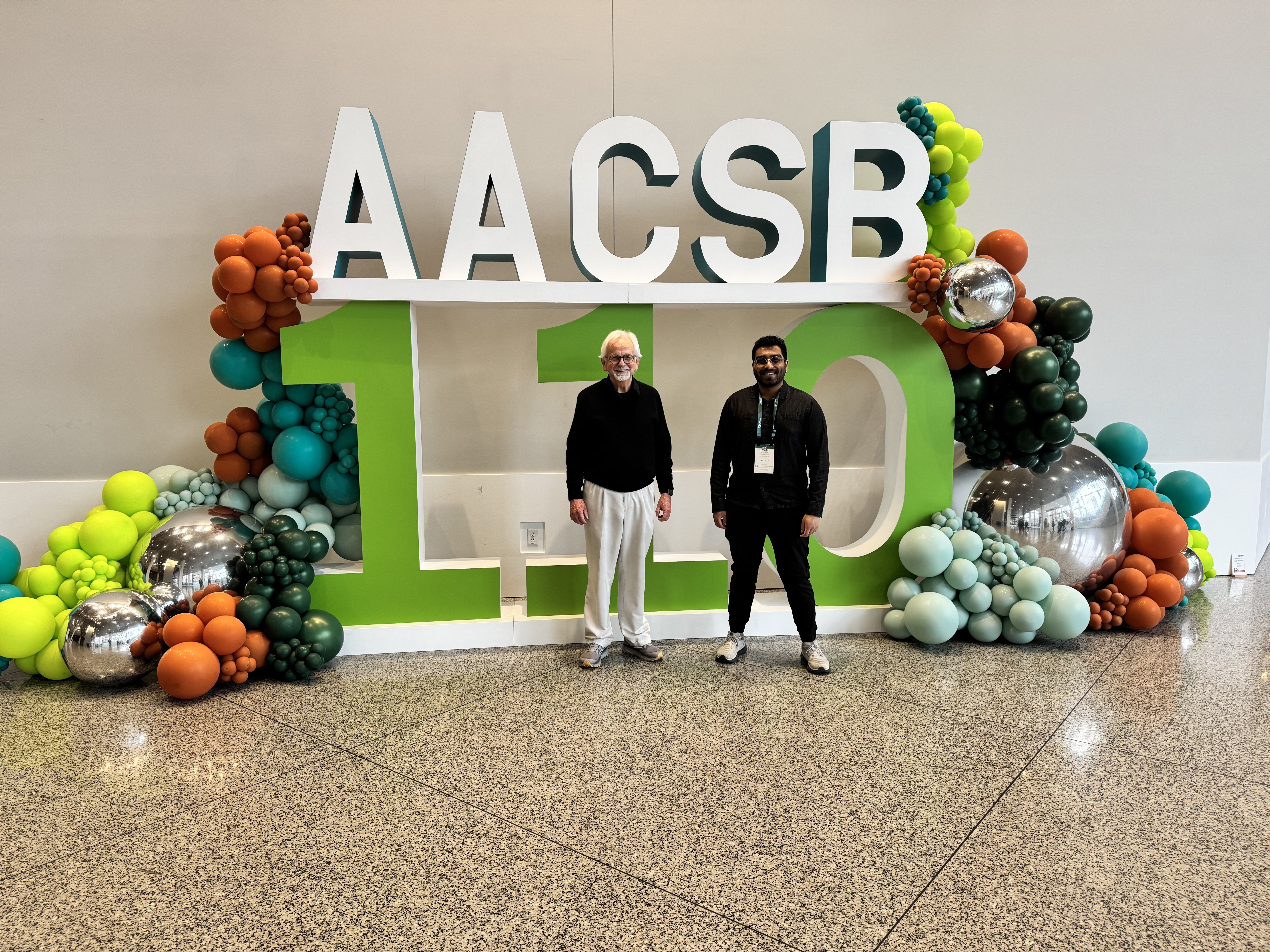
Perry Samson and Achintya Kattemalavadi at AACSB ICAM 2026 in Seattle.
Last week, Perry and I attended the AACSB ICAM 2026 conference in Seattle. It was a great opportunity to listen, learn, and understand how business schools are approaching accreditation, curriculum design, and Assurance of Learning (AoL) today.
One thing became clear very quickly: while AoL is a well-defined process, executing it in practice is anything but simple.
At its core, AoL follows a familiar cycle: define learning goals, identify where they’re taught, assess student performance, and then “close the loop” by making improvements. But in conversations with faculty and administrators, the challenge isn’t understanding the framework, it’s managing the work behind it.
Across sessions and discussions, a few patterns stood out:
Evidence gathering is time-intensive — often requiring hours of manual work across courses and systems
Insights are fragmented — spread across LMS platforms, documents, and internal tools
Coordination is difficult — too many meetings, too many moving pieces
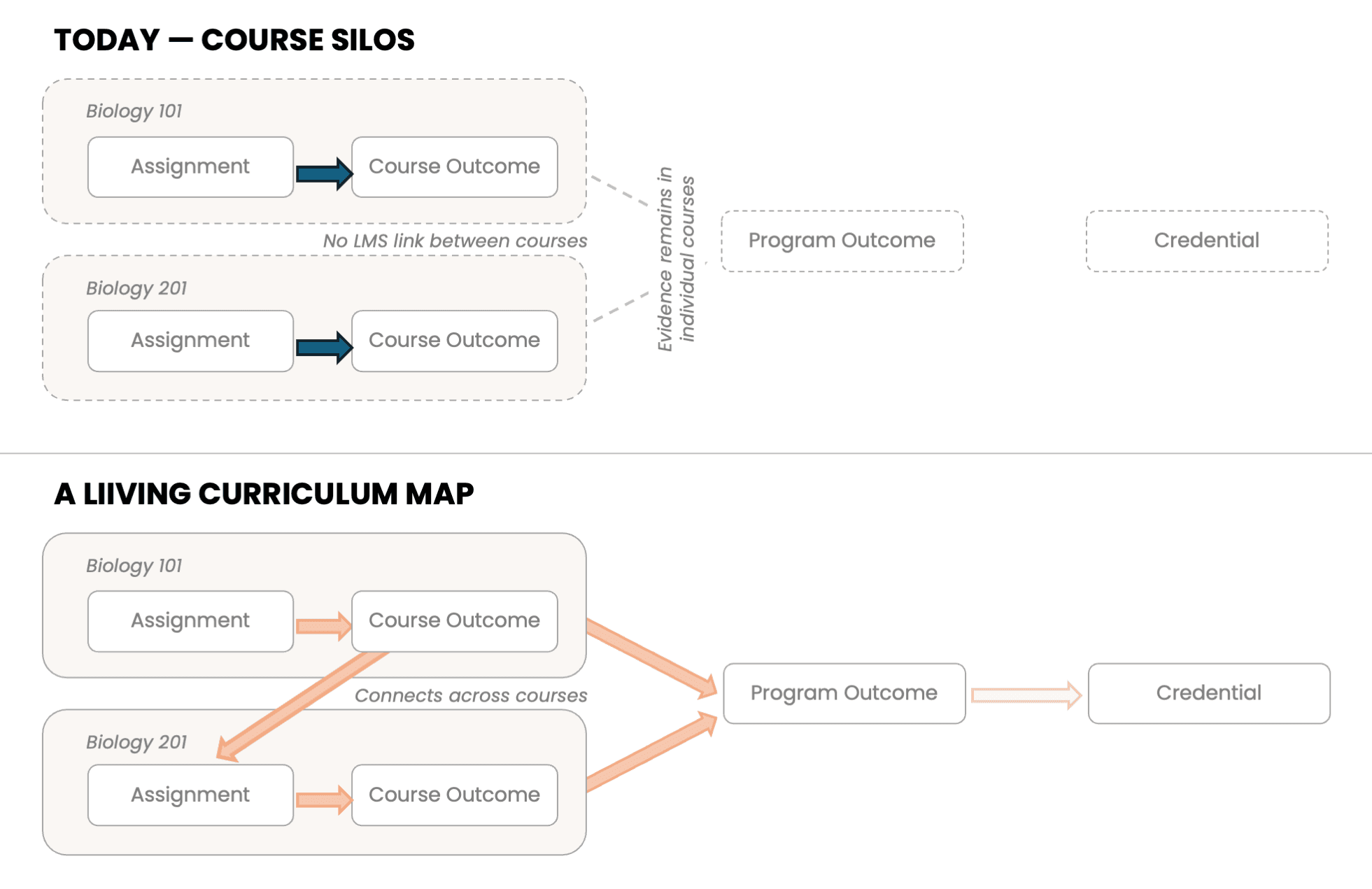
Connections across courses are hard to see — especially beyond foundational classes
In other words, the problem isn’t a lack of structure—it’s a lack of visibility and cohesion.
Where we see an opportunity
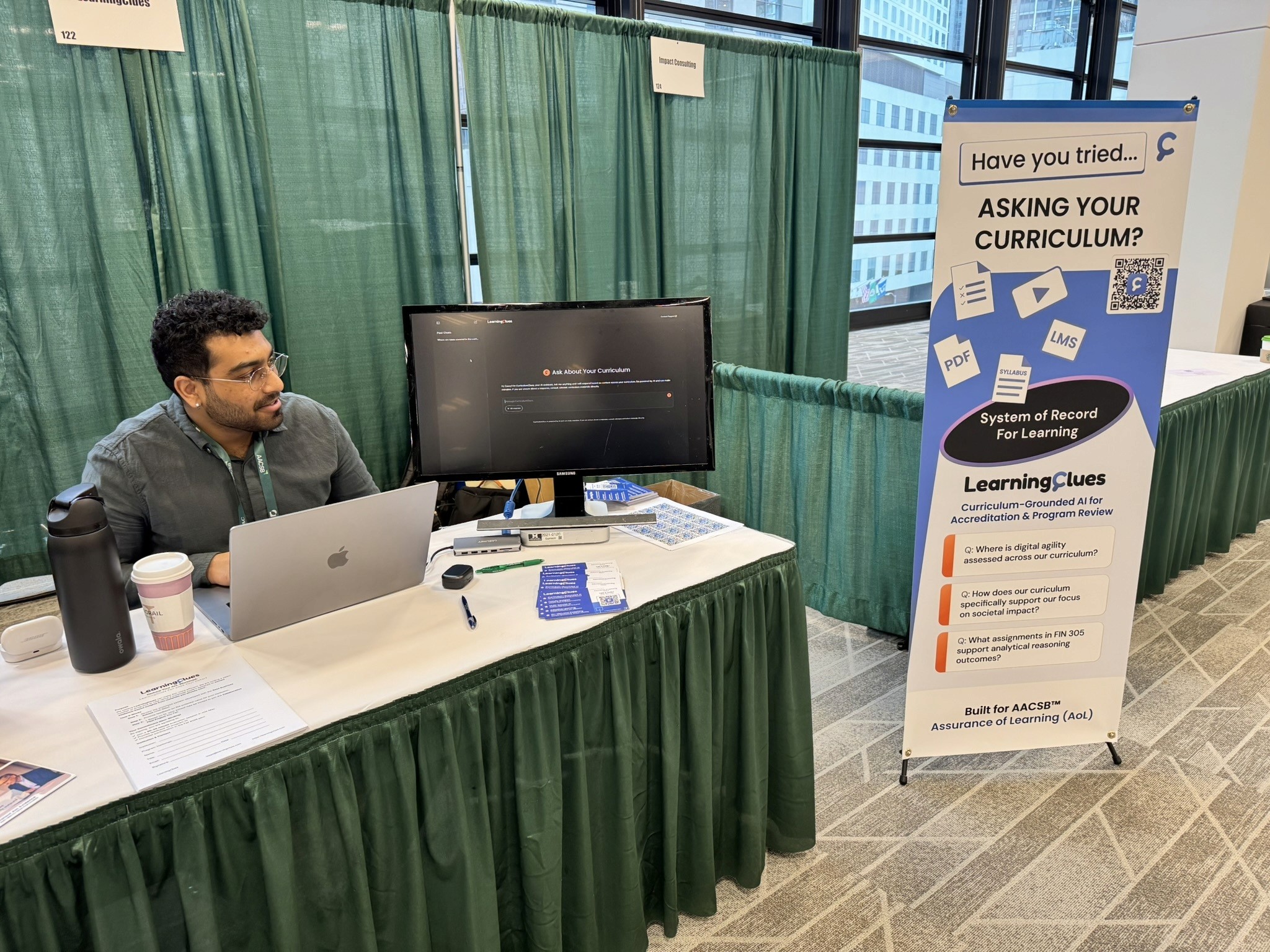
LearningClues' booth at AACSB ICAM 2026
At LearningClues, we’ve spent the past year building AI that understands course content, helping students and instructors ask questions grounded in real materials with citations.
What we’re now exploring is a natural extension of that idea:
What if you could ask questions about your entire curriculum and get insights with full citations for accreditation and program review?
Instead of manually tracing where a concept is introduced, reinforced, and assessed, what if you could simply ask:
“Where is supply & demand first introduced?”
“Where do we assess communication skills across the program?”
And get answers grounded in real course materials with detailed citations.
Working with what institutions already have
One important takeaway from AACSB was just how many tools and processes institutions already rely on. Many schools use a mix of homegrown systems, LMS data, documents, and accreditation platforms.
That raises an important question: how can new technology add value without creating more complexity?
At LearningClues, we’re exploring ways to work with existing institutional data and materials, including LMS content, course documents, and other academic sources, to help make curriculum understanding faster and easier.
This could include the ability to:
Use existing data and materials
Automatically organize and connect information
Surface grounded insights across the curriculum
The goal is simple: reduce the time it takes to understand what’s happening across a curriculum, simplify decision-making, and improve transparency.
Early thoughts on CurriculumClues
This is still early, but we’ve started prototyping what this could look like.
We’re calling it CurriculumClues—an extension of LearningClues that enables curriculum-level questions and insights.
From what we saw at AACSB, there’s strong demand for:
Automated evidence gathering
Linked insights across courses
Streamlined AoL workflows
Better visibility into how learning builds over time
These are exactly the areas we think AI can meaningfully help with, not by replacing existing processes, but by making them easier to navigate.
Looking ahead
AACSB reinforced something we’ve believed for a while:
The future of curriculum understanding isn’t just about storing data—it’s about making it askable and useful in practice.
We’re actively working with partner institutions to explore this space, refine the approach, and understand where this kind of capability can provide the most value, whether in accreditation, program review, or day-to-day academic decision-making.
If this resonates with you, we’d love to connect.
Interested in exploring curriculum-level insights? Learn more about CurriculumClues or fill out the form below to talk more!
"/><stop offset="1" stop-color="rgb(30, 137, 244)"/></linearGradient></defs><path d="M 6 0 C 9.314 0 12 2.686 12 6 C 12 9.314 9.314 12 6 12 C 2.686 12 0 9.314 0 6 C 0 2.686 2.686 0 6 0 Z" fill="url(%23YMu7oI8_W-4015704225-linear-gradient)" height="12px" id="YMu7oI8_W" transform="translate(2 2)" width="12px"/></svg>)

"/><stop offset="1" stop-color="rgb(250, 159, 254)"/></linearGradient></defs><path d="M 6 0 C 9.314 0 12 2.686 12 6 C 12 9.314 9.314 12 6 12 C 2.686 12 0 9.314 0 6 C 0 2.686 2.686 0 6 0 Z" fill="url(%23VtckAu7OE-140179840-linear-gradient)" height="12px" id="VtckAu7OE" transform="translate(2 2)" width="12px"/></svg>)
"/><stop offset="1" stop-color="rgba(255, 148, 116, 0.93)"/></linearGradient></defs><path d="M 6 0 C 9.314 0 12 2.686 12 6 C 12 9.314 9.314 12 6 12 C 2.686 12 0 9.314 0 6 C 0 2.686 2.686 0 6 0 Z" fill="url(%23iibSGr6xP-2696070145-linear-gradient)" height="12px" id="iibSGr6xP" transform="translate(2 2)" width="12px"/></svg>)