
2/3: The Missing System of Record: Why Universities Can't Measure Their Most Important Product
By
Dr. Perry J. Samson



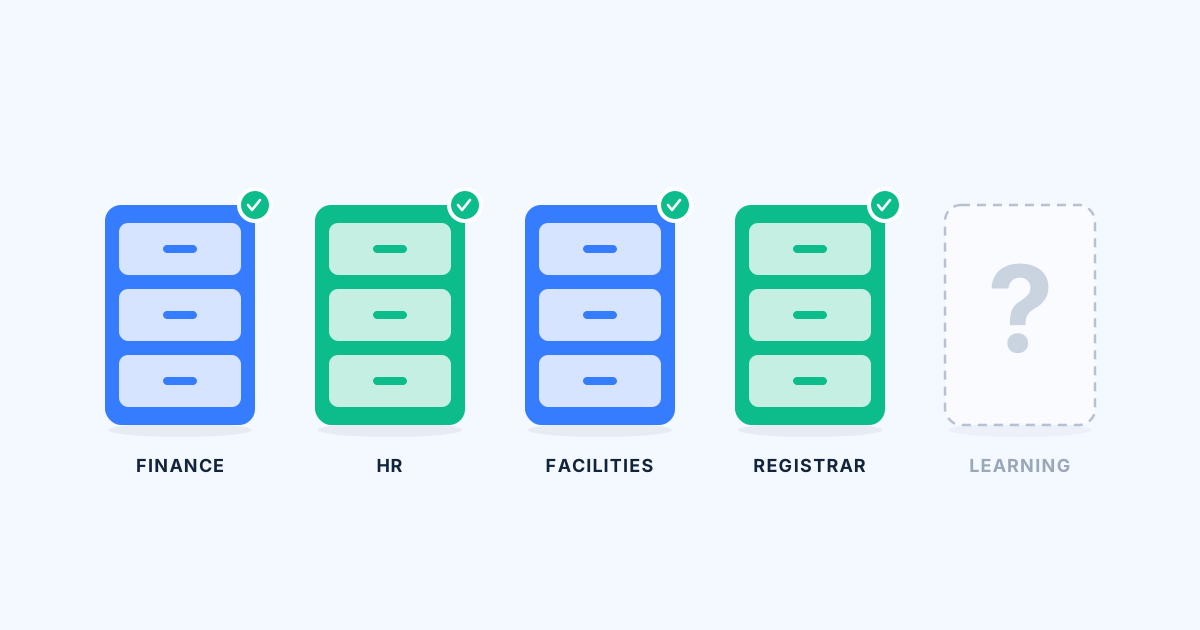
Universities keep a rigorous system of record for finance, HR, facilities, and enrollment. For learning, their actual product, there's often an empty or incomplete slot.
Every modern university runs on systems of record. The finance office has Banner or SAP. HR has Workday. The registrar has a student information system. Facilities management tracks every boiler replacement and carpet cleaning in a CMMS. These systems are expensive, carefully maintained, and fiercely defended — because leadership understands that you cannot manage what you cannot measure.
And then there is the university's actual product: what students learn in classrooms. That, apparently, we leave to chance.
The institutional amnesia at the heart of higher education
Walk through any university's technology stack and you will find a remarkable asymmetry. The hiring of an adjunct creates a permanent HR record. A pipe repair in the engineering building is logged, timestamped, and retrievable a decade later. If I want to take my laptop off-campus an audit trail gets generated. But the learning that happened in the classroom down the hall — the discussion that sparked a student's thesis, the curriculum revision that improved outcomes by 30%, the course sequence that reliably produced job-ready graduates — exists nowhere. When the professor retires, it walks out the door with them.

The discussion that sparks a thesis, the question that reframes a course — the most valuable learning happens in moments like this, and almost none of it is ever recorded.
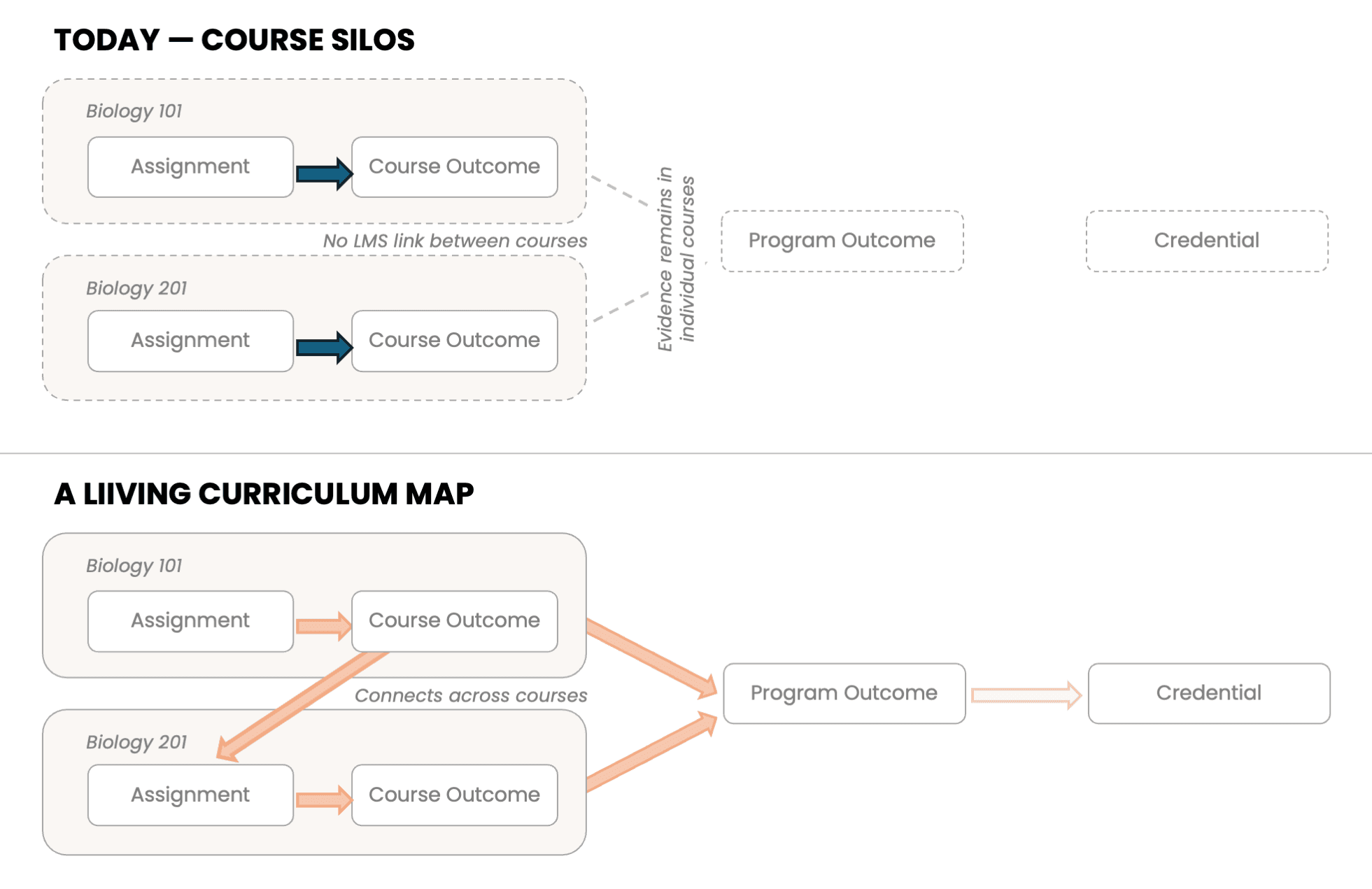
This is not a peripheral failure. Course content is currently scattered across fragmented LMS instances, personal hard drives, lecture-capture silos, and PDF syllabi emailed to students and then forgotten. Each course is essentially a standalone event. There is no institutional memory. There is no accumulation. When a department revisits its curriculum — a process that happens every few years at best — it is largely reconstructing the past from scratch.
What a system of record for learning would actually look like
A system of record is not a repository. It is not a place to store files. It is a live, queryable source of institutional truth about a domain. The financial system doesn't just store receipts — it lets the CFO ask "what did we spend on research computing over the past five years, and how does that compare to peer institutions?" A system of record for learning should be able to answer equivalent questions about curriculum.
In practical terms, this means:
A unified course content layer. Syllabi, learning objectives, lecture materials, discussion transcripts, and assessment data — pulled from wherever they already live (Canvas, Panopto, faculty uploads) and normalized into a coherent, searchable structure. The system captures content passively; it does not require faculty to do anything differently.
Learning objective mapping across a program. The system understands not just what happened in a single course, but how courses connect across a sequence, how learning objectives cascade from program goals to individual sessions, and where the gaps are. A dean of curriculum can ask: "Are our students actually being taught the quantitative reasoning skills we promise employers?" and get an evidence-based answer.
Longitudinal tracking of curricular change. When a department revises a prerequisite, changes a course sequence, or introduces new pedagogical approaches, the system records the before and after — and, over time, can surface evidence of whether the change improved student learning outcomes and downstream career results. This is the data that accreditors say they want and almost no institution can actually provide.
Differentiated views for each stakeholder audience. A provost asking "how does our business school curriculum compare to our stated program outcomes?" needs a different interface than a faculty member asking "what did I cover in ECON 302 in Spring 2025 that I should build on this semester?" or a student asking "what concepts from my prerequisite courses are most relevant to what I'm studying now?" The underlying data is the same; the lens is different.
Large language models as the organizing infrastructure
For years, the technical obstacles to building this system were formidable. Normalizing course content from dozens of incompatible formats, extracting meaningful learning objectives from prose syllabi, linking concepts across courses taught by different faculty in different styles — this required expensive, brittle custom software that most institutions could not afford to build or maintain.
Large language models change this equation entirely. An LLM can read a syllabus and extract structured learning objectives. It can watch a lecture transcript and identify the conceptual building blocks being introduced. It can map the vocabulary of a new course against the vocabulary of its prerequisites and tell an advisor where a student's preparation is strongest and where it is weakest. It can do this at scale, across an entire program, without requiring faculty to tag or annotate anything.
The key design principle is that the system should be invisible to the people generating the content. A faculty member should not need to interact with the system at all — their existing teaching workflow, within the LMS they already use, should be sufficient. The LLM layer operates in the background, reading what is already there, building a structured representation of the curriculum, and surfacing insights to the people who need them.
The evidence problem and why it matters now
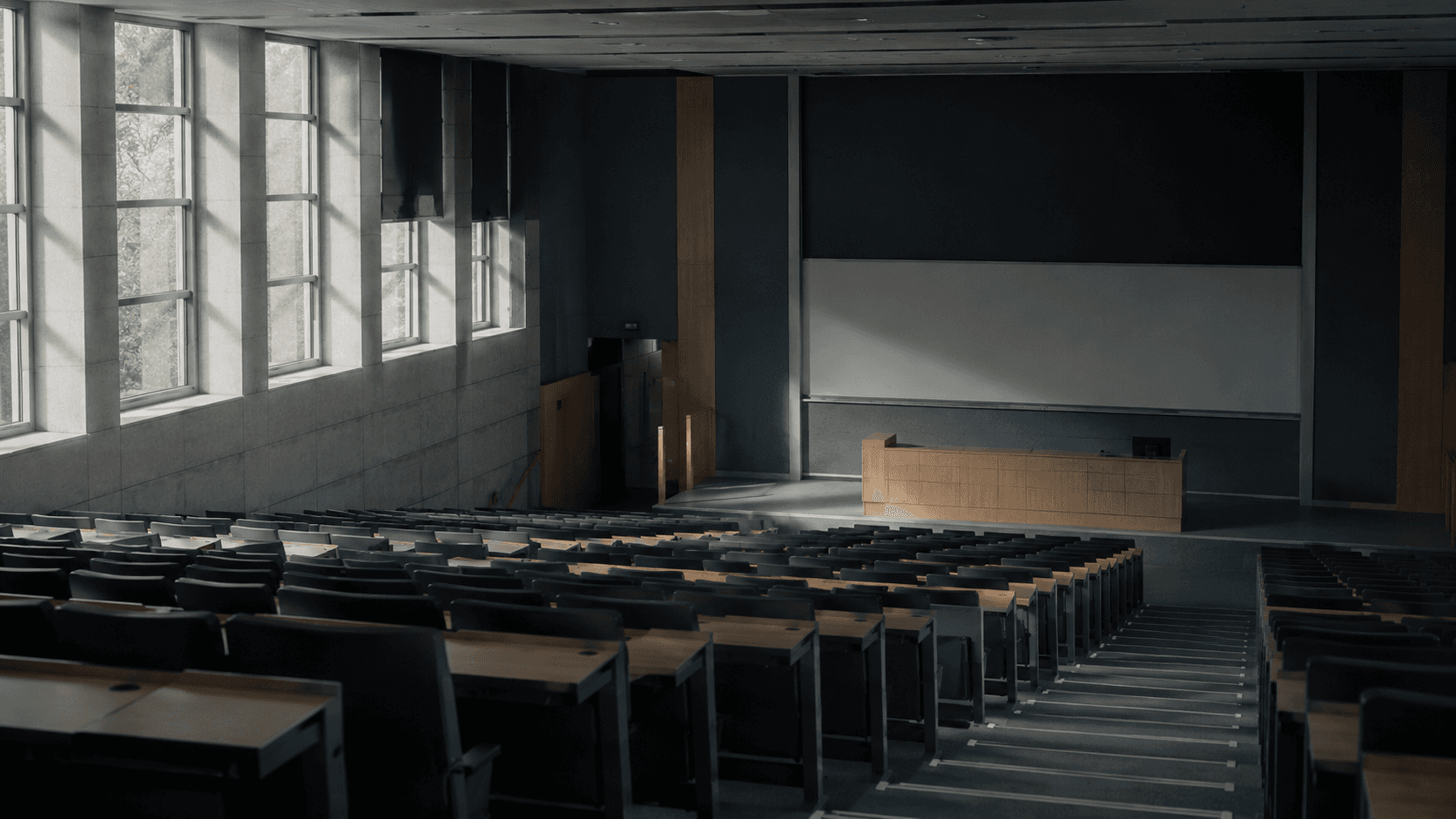
Every course is treated as a standalone event. When it ends, the learning that happened here leaves no trace the institution can return to.
Higher education is facing pressure from every direction to demonstrate value. Accreditors want evidence of student learning outcomes. Employers want graduates who can perform on day one. State legislatures want return on their investment. Students and families, bearing enormous tuition debt, want to know whether the education they are paying for is actually preparing them for a career.
Right now, most institutions cannot answer these questions with evidence. They can answer with anecdote, with graduation rates, with average starting salaries — but not with a traceable, auditable account of what was taught, how it changed over time, and what effect those changes had on students.
A system of record for learning makes this possible. Not just for accreditation reports, but as an ongoing management tool. Program review becomes a data-informed process rather than a committee exercise in collective memory retrieval. Curricular innovation becomes something institutions can actually measure. The relationship between what is taught and what students go on to do becomes visible and actionable.
Who benefits, and how
The value of this system is not uniform across stakeholders — and good system design should reflect that.
Provosts and deans need portfolio-level visibility: program health, alignment between stated outcomes and actual curriculum, evidence for accreditors, and the ability to compare departments or track trends over time. Their interface is dashboards and exception reports.
Faculty need course-level tools that make their own teaching more effective: easy access to their course history, insight into what prior courses have prepared their students with, and Socratic-style AI tools that help students without replacing the faculty relationship. Their interface is woven into the workflow they already have.
Students need a coherent map of their own learning: where they are in a program, what concepts connect across their courses, how their current coursework links to the careers they are pursuing. Their interface is personalized and forward-looking.
The democratization argument
There is a deeper point lurking beneath all of this. The institutions that can currently make evidence-based curricular decisions are the large, well-resourced research universities with dedicated institutional research offices and the staff to maintain them. Regional comprehensive universities, community colleges, professional schools, and the apprenticeship and workforce training programs that serve millions of working adults cannot afford this capacity.
A system of record for learning, built on LLM infrastructure that scales cheaply, is not just a management tool for elite universities. It is infrastructure for institutional equity. It gives the department chair at a regional state university the same analytical capacity that a research vice president at a flagship institution has — and it does so without hiring a team of data analysts or building bespoke software.
Learning is the core product of higher education. It is long past time we treated it with the same institutional seriousness we give to financial reporting, HR compliance, and building maintenance. The technology exists. The design patterns are clear. The question is whether the sector has the will to build it.

"/><stop offset="1" stop-color="rgb(30, 137, 244)"/></linearGradient></defs><path d="M 6 0 C 9.314 0 12 2.686 12 6 C 12 9.314 9.314 12 6 12 C 2.686 12 0 9.314 0 6 C 0 2.686 2.686 0 6 0 Z" fill="url(%23YMu7oI8_W-4015704225-linear-gradient)" height="12px" id="YMu7oI8_W" transform="translate(2 2)" width="12px"/></svg>)

"/><stop offset="1" stop-color="rgba(255, 148, 116, 0.93)"/></linearGradient></defs><path d="M 6 0 C 9.314 0 12 2.686 12 6 C 12 9.314 9.314 12 6 12 C 2.686 12 0 9.314 0 6 C 0 2.686 2.686 0 6 0 Z" fill="url(%23iibSGr6xP-2696070145-linear-gradient)" height="12px" id="iibSGr6xP" transform="translate(2 2)" width="12px"/></svg>)

"/><stop offset="1" stop-color="rgb(250, 159, 254)"/></linearGradient></defs><path d="M 6 0 C 9.314 0 12 2.686 12 6 C 12 9.314 9.314 12 6 12 C 2.686 12 0 9.314 0 6 C 0 2.686 2.686 0 6 0 Z" fill="url(%23VtckAu7OE-140179840-linear-gradient)" height="12px" id="VtckAu7OE" transform="translate(2 2)" width="12px"/></svg>)